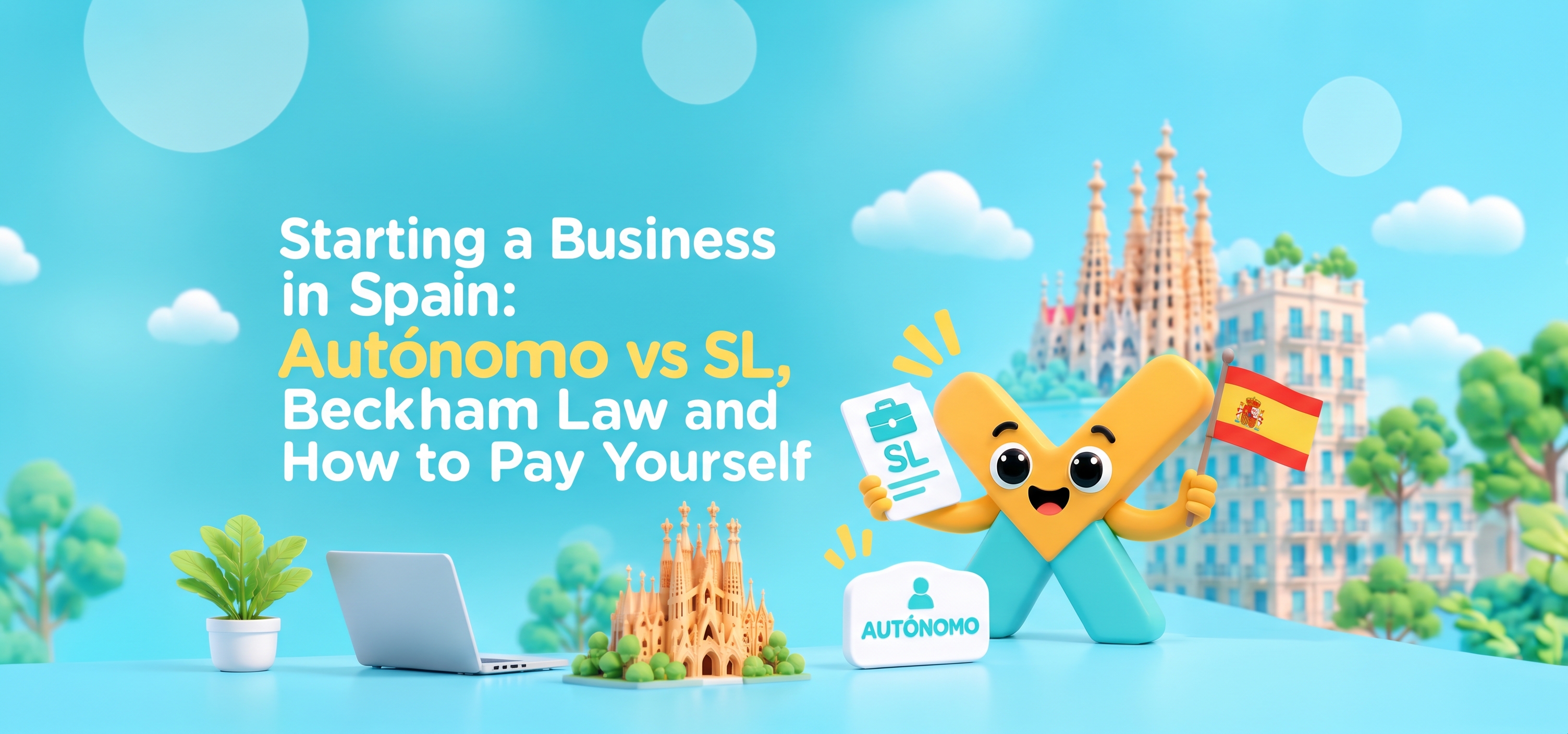
Starting a Business in Spain: Autónomo vs SL, Beckham Law and How to Pay Yourself
Starting a business in Spain involves more than choosing a name, registering a company and finding your first clients. Your business structure, personal tax residency, eligibility for special tax regimes and the way you take money out of your business can all affect your tax position.
For international entrepreneurs, freelancers and business owners moving to Spain, understanding these decisions early can help avoid unnecessary complications later.
One of the first questions is often: Should you register as an autónomo or establish a limited liability company (Sociedad Limitada, or SL)?
There is no universal answer. The right structure depends on your business model, expected profits, expenses, growth plans and personal tax situation.
If you are moving to Spain, there may also be another question to consider before choosing a structure: Could you qualify for Spain's special tax regime for inbound workers, professionals and entrepreneurs, commonly known as the Beckham Law?
Here is what to consider when starting and structuring a business in Spain.
Quick answer: Autónomo and SL are two common ways to operate a business in Spain. An autónomo generally pays personal income tax (IRPF) on business profits, while an SL is a separate legal entity generally subject to Corporate Income Tax. The best option depends on your expected profits, personal tax position, Social Security obligations, administrative costs and business plans. Entrepreneurs moving to Spain should also check whether they qualify for the Beckham Law before making structural decisions.
1. Autónomo vs SL: What is the difference?
Two common ways to operate a business in Spain are as an autónomo (self-employed individual) or through a Sociedad Limitada (SL), a limited liability company.
Although both allow you to carry out business activities, they have different legal, tax and administrative implications.
What is an autónomo in Spain?
An autónomo is a self-employed individual who carries out an economic activity in their own name.
This is a common option for freelancers, consultants, independent professionals and people starting a one-person business.
As an autónomo:
- You carry out your business activity as an individual.
- Business profits are generally included in your personal income tax calculation (IRPF).
- You may have to register with the Spanish Social Security system under the Special Regime for Self-Employed Workers (RETA), depending on your circumstances.
- You are responsible for the tax registrations, returns and other obligations associated with your activity.
When might autónomo status make sense?
It may be suitable if you are starting independently, have a relatively simple business model, provide services directly to clients or want to test a business idea before establishing a company.
However, being an autónomo does not mean having fewer obligations in every situation. Your activity, income, VAT position and other circumstances determine what you need to register for and report.
What is an SL in Spain?
A Sociedad Limitada (SL) is a separate legal entity that operates independently from its shareholders.
Unlike an autónomo, an SL is generally a separate taxpayer for Spanish Corporate Income Tax (Impuesto sobre Sociedades).
As an SL:
- The company has its own legal and tax identity.
- Company profits are generally subject to Corporate Income Tax.
- The company has accounting, bookkeeping and filing obligations.
- If you receive money from the company as salary or dividends, this can also have personal tax consequences.
- The Social Security position of company directors and shareholders must be assessed according to their actual role, ownership and working circumstances.
When might an SL make sense?
An SL may be worth considering if you plan to build a larger business, work with co-founders, hire employees, bring in investors, retain profits for business development or operate through a separate company structure.
Limited liability can help separate company obligations from shareholders' personal assets, but it is not absolute. Directors and shareholders may still have personal responsibilities in certain circumstances.
2. Autónomo vs SL: Which structure is better for taxes?
There is no universal income threshold at which an SL automatically becomes more tax-efficient than being an autónomo.
The comparison involves more than looking at the headline personal income tax rate and corporate tax rate.
| Factor | Autónomo | SL |
|---|---|---|
| Legal structure | Individual self-employed person | Separate legal entity |
| Main profit taxation | Personal Income Tax (IRPF) | Corporate Income Tax |
| Personal tax when taking money out | Business profit generally forms part of personal IRPF | Salary or dividends can create personal tax consequences |
| Accounting and administration | Generally simpler, depending on activity | More extensive company accounting and filing obligations |
| Social Security | RETA may apply, depending on circumstances | Depends on the shareholder/director's actual position |
| Retaining profits | Business income remains part of the individual's tax position | Profits can generally remain within the company after applicable taxes |
Before choosing, consider:
- Expected earnings: What do you realistically expect the business to earn?
- Business expenses: What costs will you incur to generate that income?
- Profit distribution: Will you need to withdraw most of the profits personally, or can you leave some in the company?
- Growth plans: Will you hire employees, bring in partners or seek investment?
- Administrative costs: Can the business support the additional accounting and compliance requirements of an SL?
- Personal circumstances: Where are you tax resident, and how will your business activity affect your personal tax position?
An SL does not automatically mean paying less tax. The right choice requires looking at the combined effect of company tax, personal tax, Social Security and the way profits are used.
3. Moving to Spain to start a business? Check your Beckham Law eligibility first
If you are moving to Spain to launch or run a business, it may be worth checking whether you could qualify for the special tax regime commonly known as the Beckham Law.
The regime is governed by Article 93 of Spain's Personal Income Tax Law. It allows qualifying individuals who become Spanish tax residents as a result of moving to Spain to opt for special tax treatment under certain conditions.
However, being a foreigner or moving to Spain does not automatically make you eligible.
Your reason for moving and the nature of your professional or business activity matter.
Who may qualify for the Beckham Law?
Article 93 provides different qualifying routes, including certain circumstances involving:
- Employment in Spain, including qualifying remote employment arrangements.
- Certain company administrator positions.
- Qualifying entrepreneurial activities.
- Certain highly qualified professional activities, including qualifying work connected with emerging companies or research, development and innovation.
For example, an entrepreneur moving to Spain to develop an innovative business may potentially qualify through the entrepreneurial route. This requires meeting specific statutory conditions, including the relevant ENISA assessment and immigration requirements where applicable.
Similarly, becoming a company director or setting up an SL does not automatically make someone eligible. The applicable conditions depend on the route and the individual's circumstances.
What are the main Beckham Law conditions?
Some important conditions to check include:
1. Previous tax residence
Generally, the individual must not have been a Spanish tax resident during the five tax periods before the year of the move.
2. Qualifying reason for moving
The move must meet one of the qualifying circumstances established under Article 93 and its implementing regulations.
3. Application deadline
The option is exercised through Modelo 149.
The general deadline is six months from the date the qualifying activity begins, as recorded in the Spanish Social Security registration, or from the relevant document allowing the individual to remain covered by their original country's Social Security system.
This means the deadline does not automatically run from the date you arrive in Spain.
4. Duration
The regime can generally apply during the tax period in which Spanish tax residence is acquired and the following five tax periods, provided the relevant conditions are met.
Important: Beckham Law eligibility is highly dependent on individual circumstances. Review your employment, company role, business activity and move to Spain before relying on the regime or making decisions about your business structure.
4. What happens after setting up an SL in Spain?
Incorporating a company is an important milestone, but it does not mean that every administrative and tax requirement has been completed.
Once your SL has been established, there are several areas to check before beginning operations.
Company registration and tax identification
Make sure the company formation process is complete, including the relevant registration with the Mercantile Registry.
The company also needs its tax identification number (NIF). Companies must obtain a NIF before carrying out operations with tax implications. Where a provisional NIF has been issued, the outstanding documentation required for the definitive NIF must be submitted within the applicable deadline.
Tax registration through Modelo 036
The company must communicate its tax information and relevant obligations to the Spanish Tax Agency (AEAT) through Modelo 036.
This includes information such as the company's activity, commencement date and applicable tax obligations.
The registration should reflect the company's actual activities and expected transactions.
Accounting and bookkeeping
An SL has accounting and company record-keeping obligations.
These include maintaining appropriate accounting records and preparing annual accounts in accordance with the applicable rules.
Depending on the company's activity, it may also need to manage VAT returns, withholding tax obligations, Corporate Income Tax and other filings.
Social Security and employment
If the company hires employees, the relevant employer and employee Social Security registrations and payroll obligations must be addressed.
The Social Security position of company directors and shareholders should also be assessed. It is not determined solely by the fact that someone owns shares or holds the title of director.
Ongoing compliance
Once the company starts operating, it must continue meeting its tax, accounting and corporate obligations.
These may include:
- Corporate Income Tax returns.
- VAT returns, where applicable.
- Payroll and withholding declarations, where applicable.
- Annual accounts and Mercantile Registry filings.
- Changes to company or tax information when required.
The exact requirements depend on the company's legal structure, activity and circumstances.
5. How do you pay yourself from a company in Spain?
Once your business starts generating profits, another important question comes up:
How can you take money out of your company and use it personally?
If you own an SL, company money and personal money are not interchangeable. You cannot simply treat the company's bank balance as your personal spending account.
There are different ways to receive money from your company, and each can have different tax and legal consequences.
The main options include:
Option 1: Pay yourself a salary or remuneration
You may receive remuneration for work or services performed for the company, depending on your role and the applicable legal and tax requirements.
Salary or other remuneration is generally subject to personal income tax, and the company may have payroll and withholding obligations.
The correct treatment depends on your position in the company, the nature of the remuneration and the applicable rules.
Option 2: Receive dividends
A company may distribute profits to its shareholders as dividends, subject to the relevant corporate, accounting and legal requirements.
For an individual who is a Spanish tax resident and taxed under the ordinary IRPF regime, dividends are generally treated as savings income and taxed according to the applicable savings-income scale.
The rate depends on the total taxable savings-income base and the tax year.
Option 3: Leave the profits in the company
You do not necessarily have to distribute all company profits.
After applicable company taxes, profits may be retained in the company and used for business purposes, such as:
- Investing in equipment or technology.
- Hiring employees.
- Expanding operations.
- Building working capital.
- Funding future projects.
Retaining profits can be relevant when planning the company's growth, but the company still has its own tax and accounting obligations.
6. Example: How much personal tax could you pay on a €75,000 dividend?
Let's look at an illustrative example.
Imagine you are a Spanish tax resident under the ordinary IRPF regime and receive a €75,000 dividend from a company.
Using the applicable savings-income tax bands for this example:
| Portion of dividend | Illustrative rate | Tax |
|---|---|---|
| First €6,000 | 19% | €1,140 |
| Next €44,000 | 21% | €9,240 |
| Remaining €25,000 | 23% | €5,750 |
| Total | €16,130 |
This produces an illustrative personal tax amount of approximately €16,130.
The calculation assumes that the full €75,000 is taxable dividend income, that there is no other savings income using the lower tax bands, and that the stated rates apply.
It does not account for other income, deductions, personal circumstances or tax adjustments. It also illustrates personal tax on the dividend, not the company's tax on the profits from which the dividend is distributed.
The key takeaway is simple:
€75,000 in company profits does not automatically mean €75,000 in personal spending money.
The company's tax position and your personal tax position need to be considered together.
7. What should you consider before starting a business in Spain?
Before deciding whether to become autónomo or establish an SL, take a step back and look at the bigger picture.
Ask yourself:
- Am I moving to Spain, or am I already a Spanish tax resident?
- Could I qualify for a special tax regime such as the Beckham Law?
- Will I work independently, or will I operate through a separate company?
- How much income and profit do I realistically expect?
- Will I need to withdraw most of the profits personally?
- Do I plan to reinvest profits or grow the business?
- What tax, accounting, VAT and Social Security obligations will apply?
These decisions are connected. Choosing a business structure without considering your personal tax position can lead to a decision that is not appropriate for your long-term plans.
Frequently Asked Questions
Is it better to be autónomo or set up an SL in Spain?
Neither option is automatically better. Autónomo status may suit independent professionals and smaller, simpler activities, while an SL may be appropriate for businesses with growth, investment or operational needs. The decision should consider expected profits, personal tax, company tax, Social Security, administrative costs and future plans.
How much money do you need to earn before setting up an SL in Spain?
There is no universal income threshold at which setting up an SL automatically becomes more beneficial. The decision depends on your expected profit, how much money you need personally, whether you plan to reinvest profits and the costs of running a company.
Can foreigners start a business in Spain?
Foreign nationals may be able to establish or operate a business in Spain, but their immigration status, right to work or carry out self-employed activity, and tax obligations must be considered. The requirements depend on nationality, residence status and the type of activity.
Can entrepreneurs qualify for the Beckham Law?
Certain entrepreneurs may qualify under Article 93, provided their activity and circumstances meet the applicable requirements. The qualifying entrepreneurial route involves specific conditions, including the nature of the activity, a favourable ENISA report and relevant immigration requirements.
Do I pay personal tax when I take money out of my SL?
It depends on how you receive the money. Salary and dividends have different tax treatments, while profits retained in the company are not automatically personal income. The legal basis and tax treatment of each payment must be established.
Can I keep company profits in my SL instead of paying myself?
Generally, a company can retain profits after applicable taxes and use them for business purposes, subject to company law, accounting and tax rules. Retaining profits does not make them personal funds.
What is the difference between company tax and personal income tax in Spain?
Corporate Income Tax applies to the taxable profits of a company. Personal Income Tax applies to individuals, including autónomos and individuals receiving certain types of income, such as salary or dividends. A business owner operating through an SL may need to consider both levels of taxation.
Starting a Business in Spain? Get the Right Advice Before You Decide
Choosing between autónomo and an SL is only one part of setting up a business in Spain.
Your tax residency, eligibility for special tax regimes, business model and plans for taking profits out of the company can all influence which structure makes sense.
At InnoTaxes, we help international entrepreneurs, freelancers and business owners understand their Spanish tax and accounting obligations with expert guidance and practical support.
Whether you are planning your move to Spain, setting up your first business or already managing a company, getting the right advice early can help you make informed decisions.
Explore our services or speak with an InnoTaxes tax expert to discuss your situation.
Official sources for the article:
- BOE - Personal Income Tax Law, Article 93 (special regime for inbound workers, professionals, entrepreneurs and investors)
- BOE - Personal Income Tax Regulation, Article 116 (six-month application deadline)
- BOE - Royal Decree 1008/2023 (Beckham Law qualifying routes and entrepreneurial activity)
- BOE - Corporate Income Tax Law
- BOE - Personal Income Tax savings-income scale, Article 66