If you are living and working in Spain under a Digital Nomad Visa (DNV) as a self-employed professional, your Social Security registration is an important part of your immigration compliance.
This has become particularly relevant for some DNV holders whose registration as autónomos took place later than expected.
In recent renewal cases handled by InnoTaxes, some applicants have been asked by the Unidad de Grandes Empresas y Colectivos Estratégicos (UGE) to address discrepancies between their DNV timeline and their Social Security registration.
At the same time, the DNV renewal process has changed. Since June 2026, the document-upload process used for DNV renewals has included a request for applicants to provide their complete Spanish tax declarations for the two tax years prior to renewal.
This does not necessarily mean that a new law was introduced in June. Rather, it is a change we have observed in the renewal documentation process. However, it means that applicants may now need to provide more tax information that can be compared with their other records.
For self-employed DNV holders, this makes it particularly important to understand whether there is a discrepancy between their immigration, tax and Social Security records.
What does “late autónomo registration” actually mean?
The phrase “late registration” can be confusing because the relevant date is not simply a fixed number of days after receiving a DNV.
According to the official UGE guidance for international teleworkers, applicants providing services under a professional relationship are required to commit to registering with the Spanish Special Regime for Self-Employed Workers (RETA) once the authorisation has been obtained and before beginning their activity in Spain. The guidance also states that, once registered, the obligation to contribute to the relevant Social Security regime arises.
Therefore, for the purposes of this article, we use “late autónomo registration” to generally describe a situation where a self-employed DNV holder who was required to be covered by the Spanish Social Security system began carrying out their professional activity in Spain before their effective RETA registration.
This is different from simply saying that someone registered a certain number of days or months after their DNV was approved.
The correct timeline needs to be assessed individually.
For example, you may need to compare:
- The date your DNV authorisation was granted
- The date you were authorised to begin carrying out your activity in Spain
- The date you actually started your self-employed activity
- The date you registered your economic activity with Agencia Tributaria (AEAT)
- The effective date of your registration with Tesorería General de la Seguridad Social (TGSS)/RETA
These dates do not necessarily have to be identical.
There may also be circumstances where a person remains covered by the Social Security system of another country under an applicable international Social Security agreement. The official UGE guidance specifically provides for applicants who maintain coverage in their country of origin where the relevant international rules apply and the required certificate of applicable legislation is provided.
For example, if you received your DNV, began carrying out your professional activity in Spain and were required to register with Spanish Social Security, but your effective RETA registration only took place later, there may be a discrepancy worth reviewing.
Importantly, a difference between these dates does not automatically mean that your registration was incorrect or that your DNV renewal will be rejected. The circumstances of each case need to be considered.
So, how can you tell if your registration may have been late?
Start by putting your dates in chronological order:
1. DNV approval
When was your DNV residence authorisation granted?
2. Start of activity
When did you actually begin carrying out your professional activity from Spain?
3. AEAT registration
When did you register your economic activity with the Spanish tax authorities?
4. TGSS/RETA registration
What is the effective date shown on your Social Security registration?
5. Other Social Security coverage
Were you covered by the Social Security system of another country under an applicable international agreement?
The key question is whether your Social Security coverage was consistent with the requirements applicable to your situation when you began your professional activity in Spain.
What changed in the DNV renewal process in June 2026?
Since June 2026, we have observed a change in the document-upload process for DNV residence renewals.
Among the documentation requested in the renewal process are the applicant's complete Spanish tax declarations for the two tax years prior to the renewal.
For many applicants, this means providing their Modelo 100 tax returns for the relevant years.
This is important because tax returns contain information that can be compared against other aspects of a self-employed applicant's situation, including their reported professional activity and Social Security contributions.
The official DNV process is managed by UGE, and its published requirements already include documentation relating to Social Security for self-employed applicants. The guidance states that professional teleworkers subject to the Spanish system must commit to registering with RETA after authorisation and before beginning their activity in Spain.
The June 2026 change therefore makes it particularly important for applicants to make sure that the information contained in their tax, immigration and Social Security records is consistent.
Why can a late RETA registration become an issue at renewal?
A late Social Security registration may not necessarily have caused an immediate immigration problem.
However, when you later apply to renew your DNV, UGE may have access to documentation that allows the different parts of your timeline to be examined together.
For example, your renewal documentation may show:
- when your DNV was approved;
- when you registered your activity with AEAT;
- when you were registered with RETA;
- what income you reported in your tax returns; and
- the Social Security contributions reported for the relevant periods.
If there is a significant discrepancy between these records, UGE may ask for further information or request that the applicant address the discrepancy.
This is the situation we have started seeing in some DNV renewal cases.
What are we seeing in recent cases?
In cases handled by our team, some DNV holders with later-than-expected RETA registrations have been asked to regularise or correct their Social Security registration retrospectively.
These requests can arrive through a formal requerimiento, which may give the applicant a relatively short period to respond.
In some cases we have seen, applicants have had approximately 10 working days to provide the requested information or take action.
However, this should not be understood as a universal deadline for every DNV applicant. The exact deadline depends on the individual requerimiento received.
The outcomes have also not been consistent.
Among the cases we have seen, retrospective registration requests have been:
- approved;
- partially approved;
- delayed; or
- rejected.
This is one of the reasons the situation is difficult to navigate. At present, there does not appear to be a clearly published and uniformly applied set of criteria explaining how every late-registration case will be treated.
What did TGSS tell us?
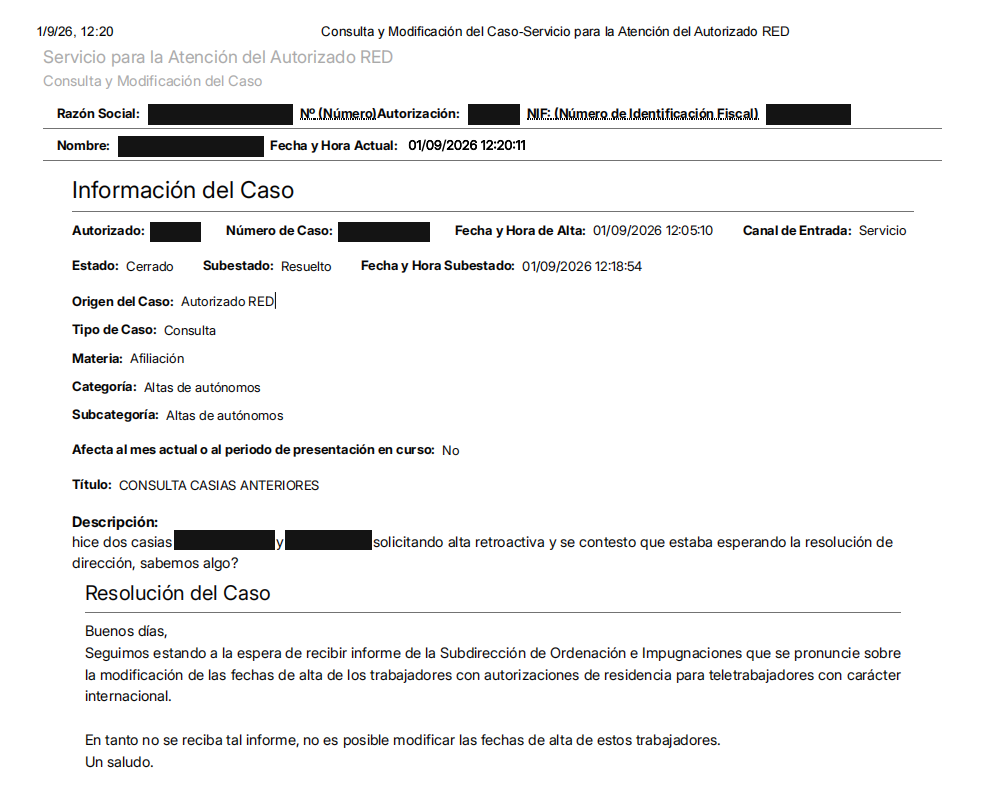
Because of the different outcomes we were seeing, our team contacted TGSS (Tesorería General de la Seguridad Social), the Spanish Social Security authority, directly to ask how these cases are currently being handled.
We were informed that the relevant departments are still awaiting further instructions from their Dirección regarding how cases involving foreign applicants and late registrations should be handled.
This information is based on our direct communication with TGSS. It should not be interpreted as a published blanket policy or as an official suspension of DNV renewals or autónomo registrations.
In particular, there is currently no basis for saying that all late registrations will be rejected or that all DNV renewals involving a late registration will be refused.
The issue is the uncertainty surrounding retrospective Social Security regularisation in these particular cases.
What should DNV holders check before renewal?
If you are a self-employed DNV holder and believe you may have registered as autónomo later than expected, it is worth reviewing your records before your renewal becomes urgent.
At a minimum, check:
1. Your DNV approval date
Check the date on your original DNV approval or residence authorisation.
2. When you actually started your activity
Look at when you began carrying out your professional activity from Spain.
This could be supported by documents such as contracts, invoices or other evidence of when the activity began.
3. Your AEAT registration
Check the effective date of your registration with the Spanish tax authorities and the activity you registered.
4. Your TGSS/RETA registration
Check the effective date, rather than simply the date on which you submitted the registration paperwork.
5. Your previous two tax returns
Review the Modelo 100 declarations relevant to your renewal and make sure the information is consistent with your actual activity.
6. Your Social Security records
Check the periods for which you were registered and the contributions associated with your self-employed activity.
7. Any other Social Security coverage
If you were covered by another country's Social Security system, check whether an applicable international agreement covered your situation and whether you have the required documentation.
8. Any correspondence from UGE
If you receive a requerimiento, read the request carefully and check the exact deadline given for responding.
Do not assume that you have a standard period of 10 working days — the deadline stated in your individual notification is what matters.
What if UGE asks you to correct your registration?
If UGE identifies a discrepancy and asks you to regularise or correct your Social Security registration, don't ignore the request.
First, establish exactly what UGE is asking you to correct and why.
Then compare:
DNV approval → start of activity → AEAT registration → TGSS/RETA registration → tax returns
You should also gather the documents that support the dates in your timeline.
Depending on the circumstances, this may include:
- your DNV approval;
- AEAT registration documents;
- RETA registration records;
- employment or professional contracts;
- invoices;
- bank records;
- Modelo 100 tax returns; and
- evidence showing when your activity actually began.
If you have received a formal requerimiento, pay particular attention to the response deadline. Missing the deadline can create an additional problem regardless of the underlying registration issue.
Is there currently an official suspension of DNV renewals?
No blanket suspension has been announced on the basis of the issue described in this article.
The concern is more specific: some DNV holders with later-than-expected RETA registrations are encountering requests to address their Social Security registration during the renewal process, and the outcomes we have seen have not been uniform.
Our team has also contacted TGSS directly and was informed that the relevant departments are awaiting further instructions regarding these cases.
The situation may therefore develop as further guidance becomes available.
The key takeaway
If you are a self-employed DNV holder, don't wait until your renewal is underway to discover that the dates in your records do not align.
A difference between your DNV approval date, start of activity, AEAT registration and RETA registration does not automatically mean that you have a problem.
But if you began your professional activity in Spain before your effective RETA registration, and you were required to be covered by the Spanish Social Security system, it is worth reviewing the situation before your renewal.
This is especially relevant now that the DNV renewal process is requesting additional tax documentation for the previous two tax years.
The safest approach is to look at your immigration, tax and Social Security records together, rather than considering each one separately.
If you are approaching your DNV renewal and are unsure whether your registration dates are aligned, consult with our tax experts at InnoTaxes.
We can review your situation, identify potential discrepancies, and help you understand what steps, if any, you may need to take before your renewal.
Disclaimer
This article is based on cases handled by InnoTaxes and information communicated directly to us by TGSS. It is provided for general informational purposes only and does not constitute legal, tax or immigration advice.
The administrative situation described above may evolve as further instructions are issued. Individual DNV and autónomo cases can differ, including where an applicant is covered by an applicable international Social Security agreement, and the applicable requirements should be assessed based on the applicant's specific circumstances.